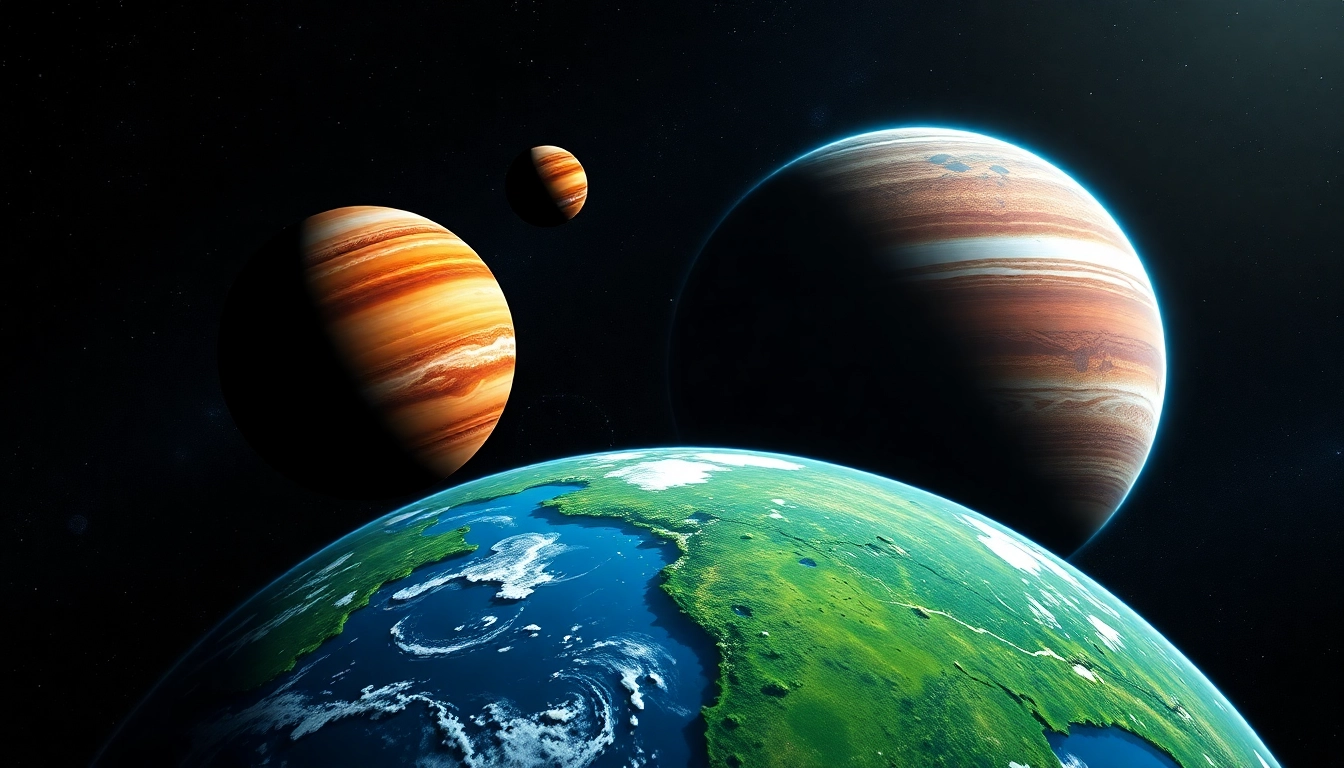
Understanding Planetary Facts
The universe is a vast and intricate place, filled with diverse celestial bodies, each possessing unique characteristics and histories. Understanding planetary facts is crucial for both scientific inquiry and educational purposes. The study of planets not only enhances our knowledge of the cosmos but also enriches our understanding of Earth's place within it.
What are Planetary Facts?
Planetary facts encompass the scientific data and characteristics associated with celestial bodies in the solar system and beyond. This includes information about their composition, atmosphere, temperature, gravity, and orbital dynamics. For example, did you know that Jupiter has the most extensive atmosphere of any planet, primarily composed of hydrogen and helium? Or that Venus has surface temperatures capable of melting lead? Such facts contribute to our understanding of these otherworldly phenomena.
Importance of Studying Planetary Facts
The exploration of planetary facts plays a pivotal role in advancing various fields of science, including astronomy, geology, and meteorology. By understanding these celestial bodies, scientists can draw parallels between Earth's processes and those occurring on other planets. This knowledge facilitates the search for extraterrestrial life, aids in predicting natural disasters, and even enhances the development of technology that can be used on Earth and in space missions.
Basic Characteristics of Planets
Each planet in the solar system exhibits unique characteristics. Fundamental planetary attributes include:
- Size: The measurement of a planet's diameter contributes to its overall classification.
- Mass: This affects gravitational pull and impacts the ability to retain an atmosphere.
- Composition: Planets can be rocky like Earth or gas giants like Jupiter, influencing surface conditions.
- Orbit: The distance from the sun results in significant variations in temperature and climate.
The Inner Planets: Mercury to Mars
Mercury: The Closest Planet
Mercury, the smallest and innermost planet of the solar system, is known for its extreme temperature fluctuations, ranging from scorching heat to freezing cold due to its thin atmosphere. With no moons or rings, Mercury's surface is scarred by numerous craters, a remnant of its tumultuous history. As it orbits the sun, the planet undergoes a unique rotational pattern, leading to long days and shorter years.
Venus: Earth’s Twin
Venus, often referred to as Earth's twin, shares similar size and composition but has starkly different conditions. Its thick atmosphere, primarily composed of carbon dioxide, traps heat, leading to surface temperatures that can reach up to 900 degrees Fahrenheit. The presence of sulfuric acid clouds adds to the planet’s hostile environment, making it uninhabitable. Despite its harsh conditions, Venus continues to be a focal point for studying atmospheric phenomena and planetary geology.
Mars: The Red Planet
Mars, known for its reddish appearance due to iron oxide, has captivated human interest for centuries. With the presence of polar ice caps, valleys, and the largest volcano in the solar system, Olympus Mons, Mars exhibits geological features similar to those on Earth. Its thin atmosphere poses challenges for potential human colonization, yet it remains a primary target for exploration and the search for past microbial life.
The Outer Planets: Jupiter to Neptune
Jupiter: The Giant of the Solar System
As the largest planet in our solar system, Jupiter is a gas giant with a mass over 300 times that of Earth. Its vibrant bands of clouds and the Great Red Spot, a colossal storm larger than Earth, showcase its dynamic atmosphere. Jupiter has a vast system of moons, including Ganymede, the largest moon in the solar system. Its magnetic field is the strongest among the planets, and ongoing exploration is revealing insights into the planet's complex inner structure.
Saturn: The Ringed Planet
Saturn is most famous for its stunning rings composed primarily of ice particles and rocky debris. This gas giant exhibits a unique atmosphere with strong winds and storm systems. Despite being less massive than Jupiter, Saturn's distinct rings and moon system, including Titan, the only moon in the solar system with a dense atmosphere, make it a focal point for research. Studies of Saturn enrich our understanding of planetary formation and the dynamics of ring systems.
Uranus and Neptune: The Ice Giants
Uranus and Neptune are referred to as ice giants due to their icy compositions and unique atmospheric conditions. Uranus’s axial tilt causes extreme seasons and creates unusual weather patterns. In contrast, Neptune is known for its vibrant blue color and the fastest winds in the solar system. Both planets offer insights into planetary atmospheres and the evolutionary history of the solar system, yet they retain many mysteries that scientists are eager to unravel.
Planetary Facts in Popular Culture
How Planetary Facts Influence Literature and Movies
Planetary facts have significant influence in literature and cinema, often serving as inspiration for storytelling. Books like Ray Bradbury’s *The Martian Chronicles* and movies such as *Interstellar* illustrate the fascination and intrigue surrounding planets. These artistic expressions help cultivate public interest in space science and can motivate future generations to explore planetary studies.
Educational Resources about Planetary Facts
Educational institutions utilize various resources to present planetary facts to students. Interactive simulations, astronomical societies, and online courses enhance learning experiences. Documentaries and engaging programs provided by NASA further open avenues for understanding. These resources enable individuals—regardless of their background—to delve into the complexities of planetary science.
The Importance of Accurate Representation
Accurate representation of planetary facts is critical in both educational and entertainment contexts. Misinformation can lead to public misunderstanding of astronomical concepts, leading to diminished interest in the sciences. Ensuring that the media correctly portrays planets can foster a deeper appreciation for our universe and its mysteries, guiding future inquiries into planetary characteristics and potential exploration endeavors.
The Future of Planetary Exploration
Current Missions to Explore Planetary Facts
Current missions, such as NASA’s Perseverance Rover on Mars and the Juno mission studying Jupiter, showcase humanity's commitment to exploring planetary facts. These missions aim to gather data crucial for understanding the formation and evolution of celestial bodies. Continued advancements in space technology promise to enhance our capabilities, leading to more profound discoveries.
Technological Advances in Astronomy
Technological advancements have revolutionized our ability to study planetary facts. Innovations such as space telescopes equipped with high-resolution cameras allow scientists to observe distant planets and gather data that was previously unachievable. These tools also facilitate collaborations among international space agencies, enabling comprehensive studies of planetary phenomena.
What Lies Beyond Our Solar System?
Our exploration of planets does not stop at our solar system. Exoplanet discovery is a burgeoning area of research that seeks to identify planets in distant solar systems. By studying their atmospheres and potential habitability, scientists hope to uncover whether life exists elsewhere in the universe. The search for planetary facts continues to expand, presenting endless possibilities for exploration and discovery.
Frequently Asked Questions (FAQs)
What are some interesting planetary facts?
Interesting planetary facts include that Mars has the largest volcano (Olympus Mons) and that Venus rotates backward. Jupiter is the most massive planet, while Neptune has the strongest winds.
How many planets are there in the solar system?
There are eight recognized planets in the solar system, which are Mercury, Venus, Earth, Mars, Jupiter, Saturn, Uranus, and Neptune.
What characterizes gas giants versus terrestrial planets?
Gas giants like Jupiter and Saturn primarily consist of gases and lack solid surfaces, while terrestrial planets like Earth and Mars have solid, rocky surfaces and are smaller in size.
Why study planetary facts?
Studying planetary facts enhances our understanding of the universe, informs us about the origins of planetary systems, and helps us predict future astronomical events and phenomena.
What future missions are planned for planetary exploration?
Future missions include NASA’s Artemis program, aimed at lunar exploration, and the Europa Clipper, which will study the icy moon of Jupiter, enhancing our understanding of potential habitability.